
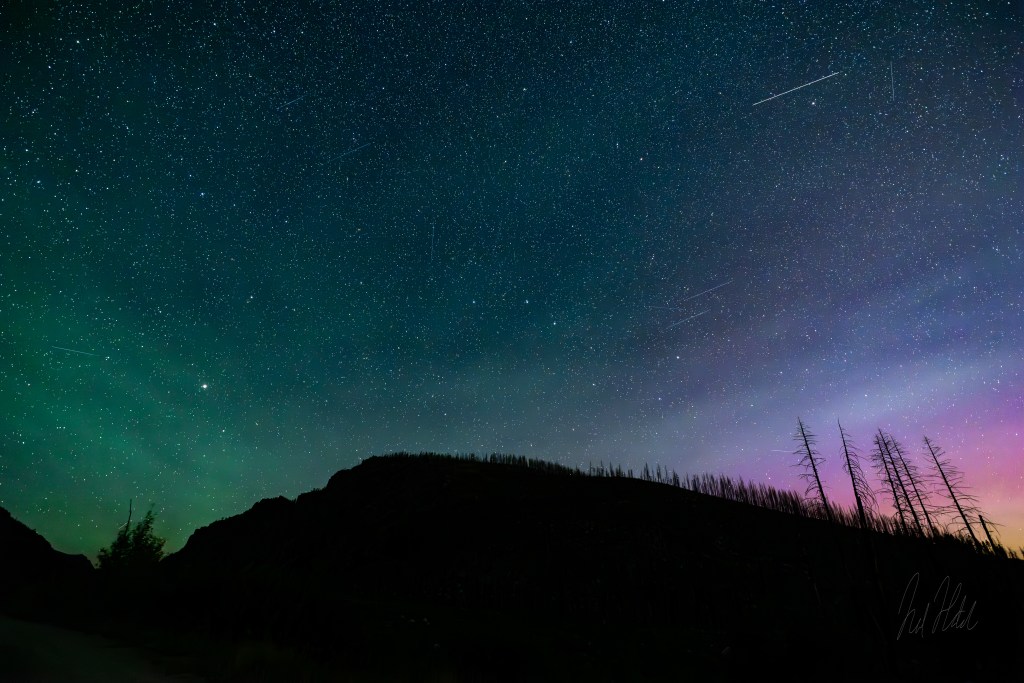
Captured August 1st, 2024 | Bitterroot Valley, Montana
On the same magical night I captured the Milky Way stretching overhead, I turned my camera toward the northern sky, hoping to catch more of the auroral activity forecasted during the recent solar storm. What unfolded was a surreal mix of atmospheric colors and meteor streaks that made this image feel like a cosmic painting.
This photo was taken with my Canon R5 and RF 15–35mm f/2.8 L IS USM lens at 16mm, 13-second exposure, f/2.8, and ISO 6400. The settings were optimized to capture as much detail as possible in the sky — from dim aurora to fleeting meteors — without completely washing out the stars.
Looking Ahead: Sharper Stars with MSM Nomad
I’ve recently added the MSM Nomad star tracker to my toolkit — a lightweight device that counteracts Earth’s rotation, allowing for longer exposures with pinpoint stars. On future outings, I plan to use this tracker to reduce motion blur and pull in even more detail from the stars and Milky Way galactic core, while also blending exposures to retain natural foreground elements.
Meteor Shower Highlights – Perseids?
You’ll notice several diagonal streaks through the frame — likely part of the Perseid meteor shower, which begins ramping up in late July and peaks in mid-August. This shot, taken just after 11 PM, coincided with increased meteor activity — adding unexpected drama to an already unforgettable sky.
Aurora in Color: Green, Yellow, Red – A Spectrum from Solar Winds
What makes auroras so captivating is their color — and those colors aren’t random. They’re the result of energetic particles from the Sun colliding with atoms and molecules in Earth’s upper atmosphere, triggering the release of visible light in specific wavelengths.
What caused it? A solar storm, triggered by multiple coronal mass ejections (CMEs), slammed Earth’s magnetic field, exciting particles in the upper atmosphere and igniting a G2-class geomagnetic storm (NOAA, 2024).
During the night this photo was taken, a G2-class geomagnetic storm created ideal conditions for viewing the aurora in Montana, well south of where it’s normally visible. Here’s a breakdown of the auroral palette visible in the image:
🟢 Green — Atomic Oxygen (Low Altitude)
- Wavelength: ~557.7 nm (green line)
- Altitude Range: ~100–150 km (60–93 miles)
- Mechanism: The most common aurora color, green light is emitted when energetic electrons collide with atomic oxygen, exciting it. When the oxygen atom returns to its ground state, it emits green photons.
- Notes: This is typically the brightest and most dominant color due to the abundance of oxygen and ideal excitation energies.
🔴 Red — Atomic Oxygen (High Altitude)
- Wavelength: ~630.0 nm (red line)
- Altitude Range: ~200–500 km (124–310 miles)
- Mechanism: Red aurora occurs higher up in the thermosphere. At these altitudes, atomic oxygen is less dense, so excited atoms can persist longer before de-exciting, resulting in red light emission.
- Notes: Because of this long-lived excitation, red aurora often appears more diffuse and subtle, though it’s quite rare in mid-latitudes — making it a treat to catch in Montana.
🟡 Yellow and Mixed Hues — Overlap of Emissions
- Mechanism: Where green and red emissions overlap, the resulting colors can blend into yellow, orange, or pinkish tones, depending on intensity and viewing angle.
- Notes: These hues are especially visible during strong solar storms when multiple altitudes of emission are active at once.
Much fainter and more transient due to rapid de-excitation and atmospheric scattering.
🟣 Purple and Blue — Molecular Nitrogen (N₂ and N₂⁺)
Occur during very high-energy auroral events.
Typically appear at lower altitudes (~80-100 km).
Foreground Challenges: Trees in Shadow
Foreground elements — like the stark silhouette of trees on the ridge provide grounding in an image like this. But without a moon or artificial light, exposing those elements is nearly impossible without blowing out the sky. On this night, the moon didn’t rise until 2:00 AM, meaning I was working with pure starlight. It’s a tradeoff: no moon means more visible stars and aurora, but less detail in terrestrial features.
Looking Ahead – Better Planning, Better Shots
While I didn’t use PhotoPills or ChatGPT to plan this shot, I’ve since started incorporating both into my workflow. Apps like PhotoPills help visualize the Milky Way’s orientation, moonrise windows, and 3D terrain, making it easier to scout ideal locations in advance. And tools like ChatGPT have been surprisingly helpful in refining those plans — offering ideas on timing, framing, and post-processing that would’ve taken hours to research on my own.
This image may have been part luck, but future ones will lean more on intention.
References & Resources
Science@NASA. (2023). The Colors of the Aurora Explained.
https://science.nasa.gov/earth-science/oceanography/living-ocean/colors-of-the-aurora/
NOAA Space Weather Prediction Center. (2024). 30-Day Geomagnetic Forecast and Aurora Alerts.
https://www.swpc.noaa.gov
NASA Goddard Space Flight Center. (n.d.). What is an Aurora?
https://www.nasa.gov/mission_pages/sunearth/aurora-overview.html
University of Alaska Fairbanks Geophysical Institute. (n.d.). Aurora Science Explained.
https://www.gi.alaska.edu/monitors/aurora-forecast
National Optical Astronomy Observatory (NOAO). (n.d.). Why are auroras different colors?
https://www.noao.edu/education/aurora.html
American Meteor Society. (2024). Perseid Meteor Shower 2024 Peak Dates and Viewing Guide.
https://www.amsmeteors.org
PhotoPills. (n.d.). Plan Milky Way and Aurora Photography with PhotoPills.
https://www.photopills.com
Time and Date. (2024). Moonrise and Moonset Tables by Location.
https://www.timeanddate.com/moon
International Dark-Sky Association. (n.d.). Tips for Astrophotography in Dark Sky Areas.
https://www.darksky.org
 Neal Hatch Photography
Leave a comment