
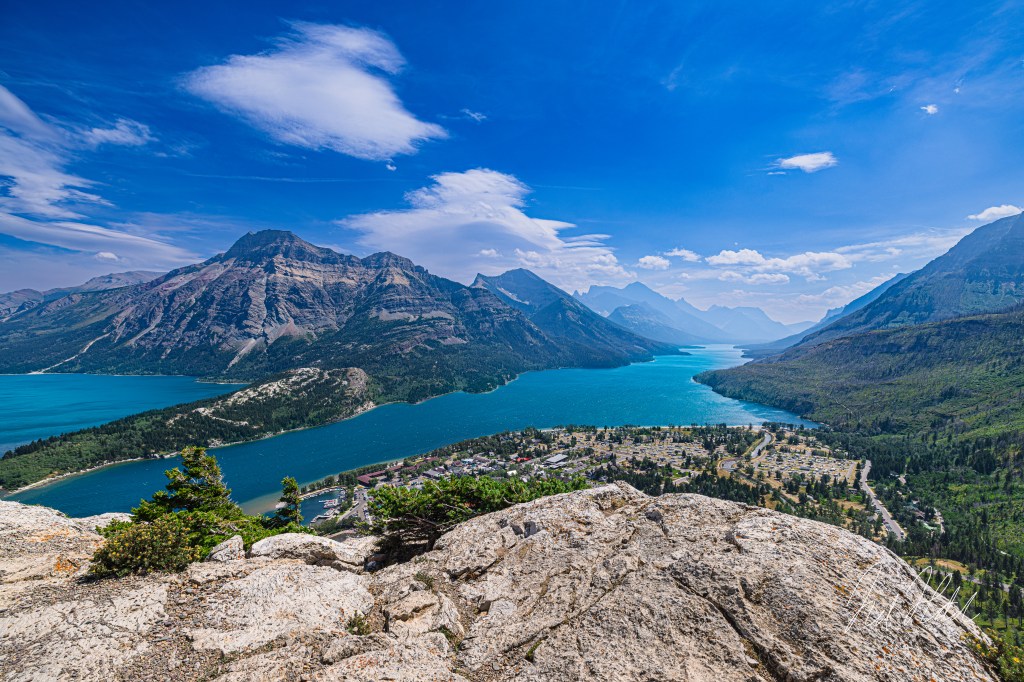
The Climb to an Iconic View
After our incredible journey through Yellowstone, we continued north into Canada, where we stayed in Waterton Lakes National Park, the northern extension of Glacier National Park. The two parks form the Waterton-Glacier International Peace Park, a UNESCO World Heritage Site and the first protected area dedicated to the friendship between Canada and the U.S.
One of the park’s most iconic hikes is the Bear’s Hump Trail, a 1.8-mile out-and-back climb with a 740-foot elevation gain. While short, the ascent is relentless, leading quickly up the exposed mountainside. But with each step, the view became more dramatic—until we reached the summit and were met with an unforgettable sight.
A View Shaped by Ice, Fire, and Wind
From the top of Bear’s Hump, we stood above Upper Waterton Lake, the deepest lake in the Canadian Rockies, plunging nearly 500 feet (150 meters) below the surface. Formed by glaciers over 10,000 years ago, its deep blues stretched between towering ridges, carving a path southward into Glacier National Park. The striking contrast of prairie meeting mountain is unique to Waterton, a place where open grasslands abruptly collide with jagged peaks—a dramatic transition shaped by ancient glaciers and the powerful forces of the Lewis Overthrust Fault (Parks Canada, 2021).
But if the view wasn’t humbling enough, the wind nearly knocked us off our feet. Waterton is famous for its extreme Chinook winds, which can reach hurricane-force speeds over 90 mph (145 km/h) (Lutgens & Tarbuck, 2019). These warm, dry winds sweep down the mountains, sculpting the land and making even standing still at the summit a challenge. We found ourselves bracing against gusts that made the climb feel effortless in comparison.
Capturing the Moment
With the wind howling around us, I quickly set up my camera—Canon R5 with an RF 15-35mm lens at 16mm—to capture the vastness of the view. I used 1/500s at f/8.0, ISO 100, ensuring clarity from the rocky foreground to the distant peaks. The fast shutter speed helped freeze the movement of the windswept vegetation, while the wide focal length captured the lake’s full grandeur as it disappeared into the mountains.
Despite the fierce conditions, there was an undeniable beauty in the experience. The lake, the ridges, the ever-changing clouds—they all told a story of millions of years of geological transformation and the raw power of nature (Geological Survey of Canada, 2021).
A Landscape Rich in History
Looking down from Bear’s Hump, I couldn’t help but reflect on the significance of this place—not just in terms of scenery, but in history. For thousands of years, this land has been home to the Blackfoot Confederacy (Niitsitapi), who consider Waterton sacred and refer to it as “The Place Where the Mountains Meet the Prairie” (Blackfoot Confederacy, 2022).
Their deep connection to the land predates national park boundaries, and their presence is still felt throughout Waterton, from preserved archeological sites to the cultural stories tied to the region. Standing there, surrounded by the forces of wind and time, it was easy to see why this landscape has long been revered.
The Reward of Bear’s Hump
The journey up Bear’s Hump isn’t just about the view—it’s about experiencing the elements that define Waterton. The steep climb, the roaring wind, the deep blues of the lake below—it all comes together in a way that reminds you just how alive this place is.
As we made our way back down, the wind still howling through the ridges, I carried with me not just a photograph, but a deeper appreciation for the wild forces that shaped this land. Waterton isn’t just a place to see—it’s a place to feel. There is something humbling about standing amongst such vastness. I encourage you to add this place onto your next Glacier National Park adventure!
If you would like to see more of my work as I add to my growing website, please visit my Gallery. There is lots more to come, stay tuned!
References
• Blackfoot Confederacy. (2022). Blackfoot history and culture. Retrieved from blackfootconfederacy.ca
• Geological Survey of Canada. (2021). Waterton Lakes National Park: A geological history. Natural Resources Canada. Retrieved from nrcan.gc.ca
• Lutgens, F., & Tarbuck, E. (2019). The Atmosphere: An Introduction to Meteorology. Pearson Education.
• Parks Canada. (2023). Waterton Lakes National Park: History and Nature. Retrieved from parks.canada.ca


 Neal Hatch Photography