
Tag: photography

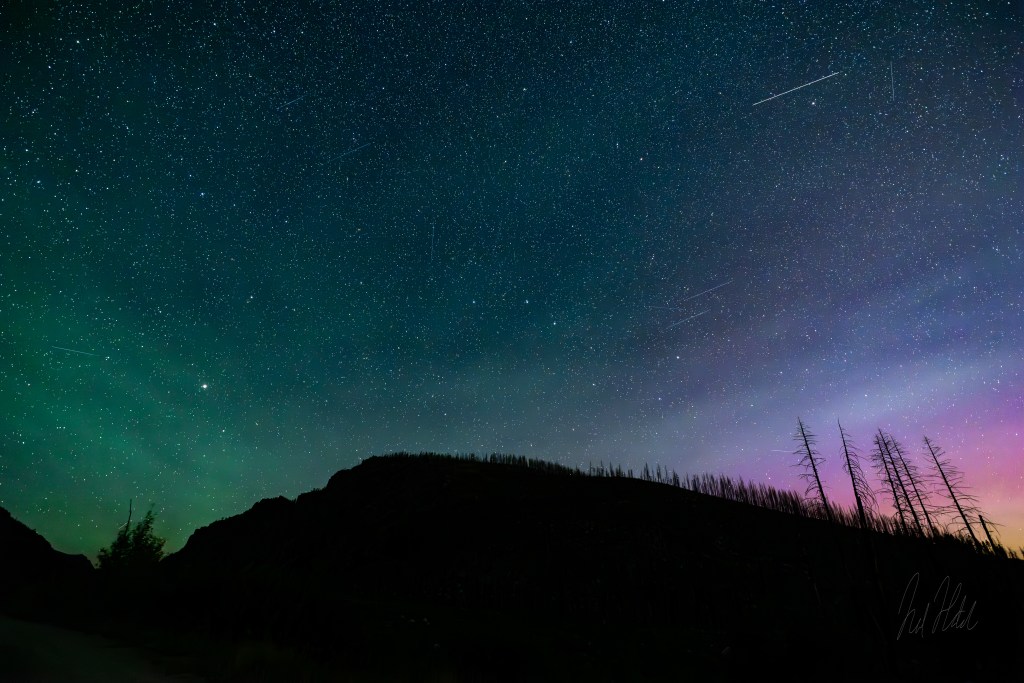
  • Northern Lights and Fire in the Sky – Aurora and Meteors over Bitterroot

    Aurora borealis and possible Perseid meteors streak over the northern Bitterroot Valley. Captured at 16mm | f/2.8 | ISO 6400 | 13 seconds. Red, green, and yellow auroral hues enhanced from naturally occurring atmospheric emission.

    Captured August 1st, 2024 | Bitterroot Valley, Montana

    On the same magical night I captured the Milky Way stretching overhead, I turned my camera toward the northern sky, hoping to catch more of the auroral activity forecasted during the recent solar storm. What unfolded was a surreal mix of atmospheric colors and meteor streaks that made this image feel like a cosmic painting.

    This photo was taken with my Canon R5 and RF 15–35mm f/2.8 L IS USM lens at 16mm, 13-second exposure, f/2.8, and ISO 6400. The settings were optimized to capture as much detail as possible in the sky — from dim aurora to fleeting meteors — without completely washing out the stars.

    Looking Ahead: Sharper Stars with MSM Nomad

    I’ve recently added the MSM Nomad star tracker to my toolkit — a lightweight device that counteracts Earth’s rotation, allowing for longer exposures with pinpoint stars. On future outings, I plan to use this tracker to reduce motion blur and pull in even more detail from the stars and Milky Way galactic core, while also blending exposures to retain natural foreground elements.

    Meteor Shower Highlights – Perseids?

    You’ll notice several diagonal streaks through the frame — likely part of the Perseid meteor shower, which begins ramping up in late July and peaks in mid-August. This shot, taken just after 11 PM, coincided with increased meteor activity — adding unexpected drama to an already unforgettable sky.

    Aurora in Color: Green, Yellow, Red – A Spectrum from Solar Winds

    What makes auroras so captivating is their color — and those colors aren’t random. They’re the result of energetic particles from the Sun colliding with atoms and molecules in Earth’s upper atmosphere, triggering the release of visible light in specific wavelengths.

    What caused it? A solar storm, triggered by multiple coronal mass ejections (CMEs), slammed Earth’s magnetic field, exciting particles in the upper atmosphere and igniting a G2-class geomagnetic storm (NOAA, 2024).

    During the night this photo was taken, a G2-class geomagnetic storm created ideal conditions for viewing the aurora in Montana, well south of where it’s normally visible. Here’s a breakdown of the auroral palette visible in the image:

    🟢 Green — Atomic Oxygen (Low Altitude)

    • Wavelength: ~557.7 nm (green line)
    • Altitude Range: ~100–150 km (60–93 miles)
    • Mechanism: The most common aurora color, green light is emitted when energetic electrons collide with atomic oxygen, exciting it. When the oxygen atom returns to its ground state, it emits green photons.
    • Notes: This is typically the brightest and most dominant color due to the abundance of oxygen and ideal excitation energies.

    🔴 Red — Atomic Oxygen (High Altitude)

    • Wavelength: ~630.0 nm (red line)
    • Altitude Range: ~200–500 km (124–310 miles)
    • Mechanism: Red aurora occurs higher up in the thermosphere. At these altitudes, atomic oxygen is less dense, so excited atoms can persist longer before de-exciting, resulting in red light emission.
    • Notes: Because of this long-lived excitation, red aurora often appears more diffuse and subtle, though it’s quite rare in mid-latitudes — making it a treat to catch in Montana.

    🟡 Yellow and Mixed Hues — Overlap of Emissions

    • Mechanism: Where green and red emissions overlap, the resulting colors can blend into yellow, orange, or pinkish tones, depending on intensity and viewing angle.
    • Notes: These hues are especially visible during strong solar storms when multiple altitudes of emission are active at once.

    Much fainter and more transient due to rapid de-excitation and atmospheric scattering.

    🟣 Purple and Blue — Molecular Nitrogen (N₂ and N₂⁺)

    Occur during very high-energy auroral events.

    Typically appear at lower altitudes (~80-100 km).

    Foreground Challenges: Trees in Shadow

    Foreground elements — like the stark silhouette of trees on the ridge provide grounding in an image like this. But without a moon or artificial light, exposing those elements is nearly impossible without blowing out the sky. On this night, the moon didn’t rise until 2:00 AM, meaning I was working with pure starlight. It’s a tradeoff: no moon means more visible stars and aurora, but less detail in terrestrial features.

    Looking Ahead – Better Planning, Better Shots

    While I didn’t use PhotoPills or ChatGPT to plan this shot, I’ve since started incorporating both into my workflow. Apps like PhotoPills help visualize the Milky Way’s orientation, moonrise windows, and 3D terrain, making it easier to scout ideal locations in advance. And tools like ChatGPT have been surprisingly helpful in refining those plans — offering ideas on timing, framing, and post-processing that would’ve taken hours to research on my own.

    This image may have been part luck, but future ones will lean more on intention.

    References & Resources

    Science@NASA. (2023). The Colors of the Aurora Explained.
    https://science.nasa.gov/earth-science/oceanography/living-ocean/colors-of-the-aurora/

    NOAA Space Weather Prediction Center. (2024). 30-Day Geomagnetic Forecast and Aurora Alerts.
    https://www.swpc.noaa.gov

    NASA Goddard Space Flight Center. (n.d.). What is an Aurora?
    https://www.nasa.gov/mission_pages/sunearth/aurora-overview.html

    University of Alaska Fairbanks Geophysical Institute. (n.d.). Aurora Science Explained.
    https://www.gi.alaska.edu/monitors/aurora-forecast

    National Optical Astronomy Observatory (NOAO). (n.d.). Why are auroras different colors?
    https://www.noao.edu/education/aurora.html

    American Meteor Society. (2024). Perseid Meteor Shower 2024 Peak Dates and Viewing Guide.
    https://www.amsmeteors.org

    PhotoPills. (n.d.). Plan Milky Way and Aurora Photography with PhotoPills.
    https://www.photopills.com

    Time and Date. (2024). Moonrise and Moonset Tables by Location.
    https://www.timeanddate.com/moon

    International Dark-Sky Association. (n.d.). Tips for Astrophotography in Dark Sky Areas.
    https://www.darksky.org

  • Stars Aligned: Photographing a Solar Storm and the Milky Way in Montana

    Milky Way meets emerald aurora—a spectacular August night near Hamilton, MT in Montana’s Bitterroot Valley. Captured with Canon R5, RF15-35mm lens at 16mm | 13.0s | f/2.8 | ISO 6400

    A Bitterroot Night to Remember

    On a cool summer night just outside Hamilton, Montana, near the Goat Mountain trailhead, I set up my Canon R5 and L-series 15–35mm lens to try and capture something I’d only hoped for — a clear Milky Way over the Bitterroot Valley. What I didn’t expect was the ghostly green aurora dancing on the horizon, a rare treat in this part of the country, made possible by a powerful solar storm.

    This image was taken at 16mm, f/2.8, ISO 6400, with a 13-second exposure. At that exposure length, you’ll notice subtle star trails — a reminder of Earth’s rotation during longer captures. The longer exposure allow me to bring more of the green solar storm hue into the image as it was fairly faint against the hazy sky.

    The green hue you see is not an artifact — it’s an enhanced but real aurora caused by multiple coronal mass ejections (CMEs) during this period. NOAA had issued a G2 geomagnetic storm watch for July 31st into August 1st, 2024. We were lucky — wildfires in Canada and Idaho had threatened to obscure the skies, but for one night, the winds were favorable!

    The Bitterroot Valley: A Place of Deep Roots and Open Skies

    In modern times, the valley has become a sanctuary for those seeking unspoiled views of the night sky. Its relative remoteness and low light pollution offer rare opportunities for stargazing and astrophotography. I hope to explore more foreground options on my 2025 visit.

    Planning the Shot: Luck + Intention

    Photography, especially of the night sky, is a mix of being in the right place at the right time — and knowing how to plan for that moment. I’ve recently been learning to use the PhotoPills app, which helps forecast the Milky Way’s position, moon phases, and potential visibility based on time and location. That planning paid off, as August is when the galactic core of the Milky Way arcs prominently across Montana’s summer sky, tilted almost vertically just after nightfall. For next year’s trip, I will be well prepared to improve the foreground element positioning, lets just hope we get another solar storm!

    But nothing’s guaranteed. Fires, weather, and solar activity are all variables beyond our control. Still, you can increase your odds with research, timing, and a healthy dose of patience.

    Looking Ahead: Sharper Stars with MSM Nomad

    I’ve recently added the MSM Nomad star tracker , an affordable simple to use tracker, to my toolkit. The lightweight device counteracts Earth’s rotation, allowing for longer exposures with pinpoint stars. It does require some user fine tuning and alignment with polaris, the north star, all of which I am still learning! The tracker will allow me to extend exposure time to several minutes improving signal to noise on the sensor. On future outings, I plan to use this tracker to reduce motion blur and pull in even more detail from the galactic core, while also blending exposures to retain natural foreground elements.

  • The Living Palette: Capturing the Colors of Grand Prismatic Spring

    grand prismatic spring Yellowstone national park
    The Grand Prismatic Spring, Yellowstone National Park. Shot with Canon R5 RF15-35mm f/2.8 L lens 1/250s | f/5.6 | ISO 100

    Some places in nature feel like they belong to another world entirely. Grand Prismatic Spring is one of those places—a surreal masterpiece where geology, biology, and light converge to create an otherworldly display of color and steam. Standing before this iconic thermal feature feeling the heat and power of nat, I felt a sense of awe not just at its beauty but at the forces of nature that have shaped it over time.

    A Vibrant History
    Grand Prismatic Spring, the largest hot spring in Yellowstone and the third largest in the world, has captivated explorers and visitors for centuries. First documented by the Hayden Geological Survey in 1871, the spring was named for its striking rainbow-like colors, which mimic the optical phenomenon of light splitting into a spectrum. But long before this scientific expedition, Indigenous peoples revered Yellowstone’s thermal features, including Grand Prismatic, as sacred spaces with medicinal properties.

    Nature’s Paintbrush
    At approximately 370 feet in diameter and over 120 feet deep, Grand Prismatic Spring dwarfs everything around it, commanding attention with its sheer scale and intense colors. The vibrant hues come from layers of heat-loving microorganisms, or thermophiles, that thrive in the extreme temperatures of the spring.

    • The Blue Center: The deep blue at the heart of the spring is the result of high temperatures that inhibit most microbial life, allowing light to scatter and intensify the blue wavelengths.
    •  The Orange and Red Rings: The outer edges teem with thermophiles that create fiery tones as they adapt to slightly cooler temperatures. These rings change with the seasons, becoming more vivid in summer.

    A Photographer’s Dream
    This photograph was taken on a warm afternoon when the golden sunlight enhanced the already vivid colors of the spring. Using a Canon R5 and an RF 15-35mm f/2.8 L lens set to 15mm, I was able to capture the full scope of the spring’s beauty. The settings—1/250 sec, f/5.6, ISO 100—helped balance the bright sky and the intricate details of the microbial mats in the foreground.

    The winding orange and red patterns in the foreground drew my eye as I composed the shot. These lines not only guide the viewer’s gaze into the heart of the spring but also tell a deeper story of the geological and biological processes at play. The ethereal steam rising from the spring, set against the lush green backdrop of the surrounding hills, felt like nature’s way of completing the palette.

    The Legacy of Discovery
    Grand Prismatic Spring isn’t just a visual marvel; it’s a testament to the dynamic forces beneath Yellowstone. The superheated water bubbling to the surface is powered by the massive Yellowstone Caldera, a supervolcano lying dormant beneath the park. This connection to Yellowstone’s volcanic past reminds us of the incredible energy and history that shape this landscape.

    As I walked away from the spring, I couldn’t help but think of the explorers who first documented it, marveling at its alien beauty. It’s a place that transcends time, a living palette that continues to inspire photographers, scientists, and visitors alike.

    If you would like to see more of my work or perhaps bring one into your home, please see my Darkroom.com Gallery

    References

    • National Park Service. “Yellowstone National Park: Grand Prismatic Spring.” nps.gov.
    • Smith, Robert B. “The Yellowstone Volcano.” Geological Society of America, 2003.
  • Chasing Light at Artist Point: A Tribute to Yellowstone’s Timeless Beauty

    Yellowstone falls viewed from artist point after sunset Yellowstone national park
    Artist Point, Yellowstone National Park. Shot after sunset. Canon R5 RF15-35mm f/2.8 L lens shot at 35mm | 1/160s | f/2.8 | ISO 800

    This photograph, taken after sunset at Artist Point in July, captures the serene yet dramatic beauty of Yellowstone’s Grand Canyon. The rugged canyon walls, glowing with warm tones, guide the eye toward the majestic Lower Falls. The vibrant post-sunset sky, with its soft pinks and oranges, contrasts against the darker shadows of the canyon, evoking a harmonious blend of power and tranquility.

    This image was shot with a Canon R5 and an RF 15-35mm f/2.8 L lens set at 35mm. The settings—1/160 sec, f/2.8, ISO 800—allowed for sharp details in the low-light conditions while preserving the natural vibrancy of the scene. The wide aperture helped isolate the intricate textures of the canyon walls and ensure clarity in the distant falls.

    This shot draws inspiration from the legendary work of Ansel Adams, who immortalized Yellowstone’s landscapes in his timeless black-and-white photography. Adams’ ability to emphasize texture, light, and shadow resonates in this image, though it leans into color to showcase the transient beauty of the moment. The post-sunset sky, alive with hues that Adams could only imply in grayscale, serves as a tribute to the dynamic range of light that modern technology allows us to capture.

    Moments like these remind us why Artist Point has been a muse for countless photographers.

    If you would like to see more of my work or perhaps bring one into your home, please see my Darkroom.com Gallery